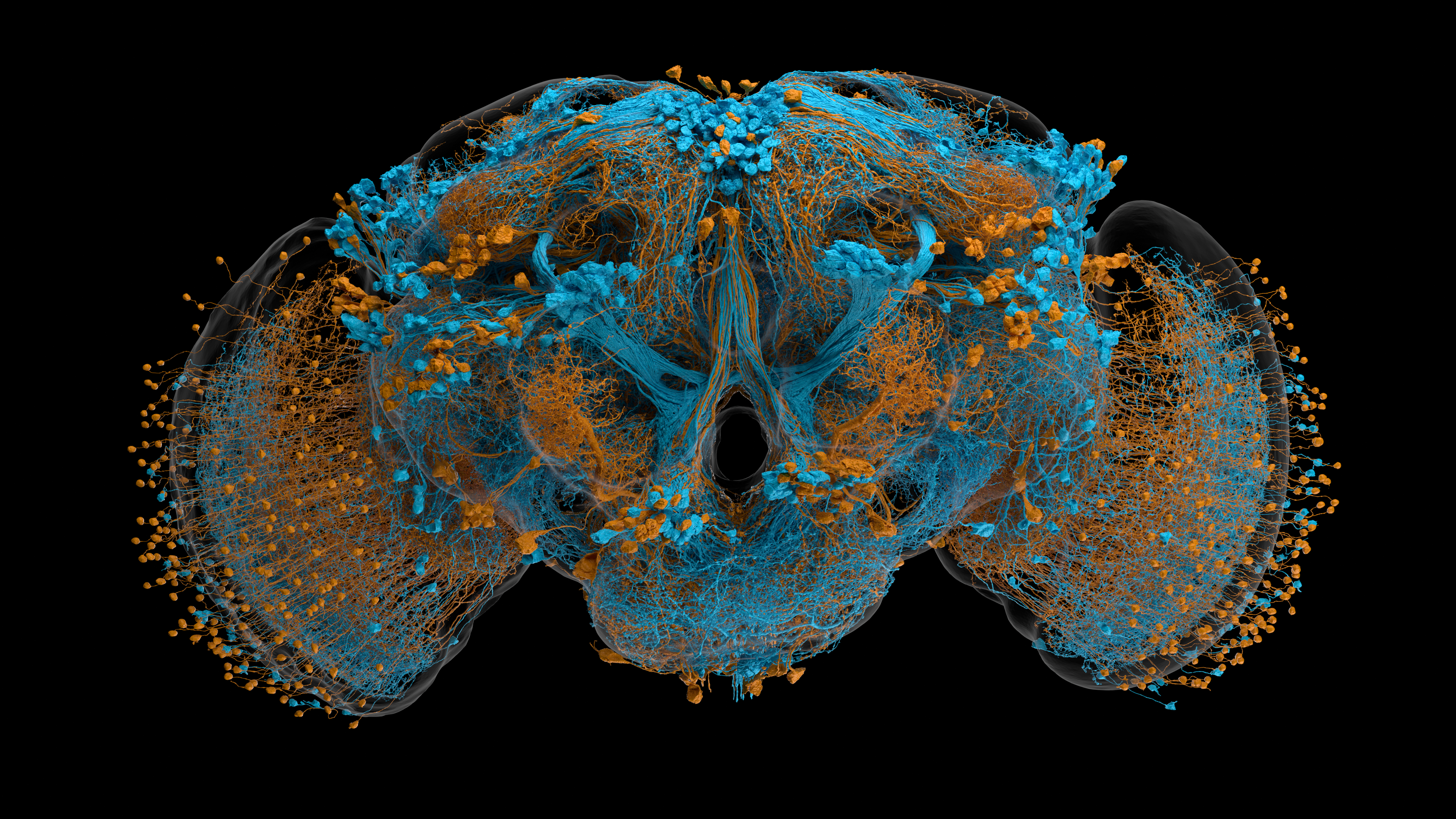
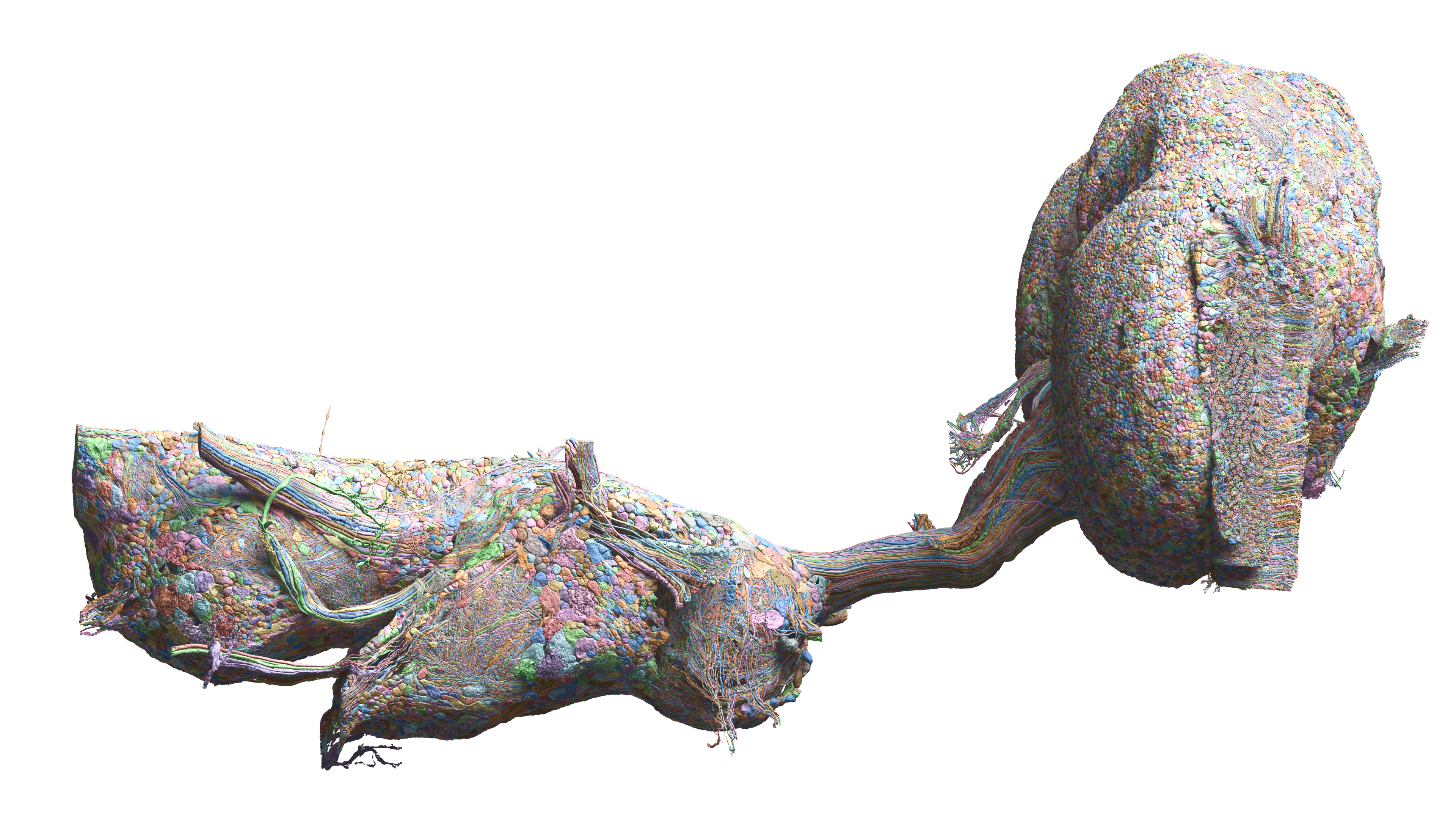
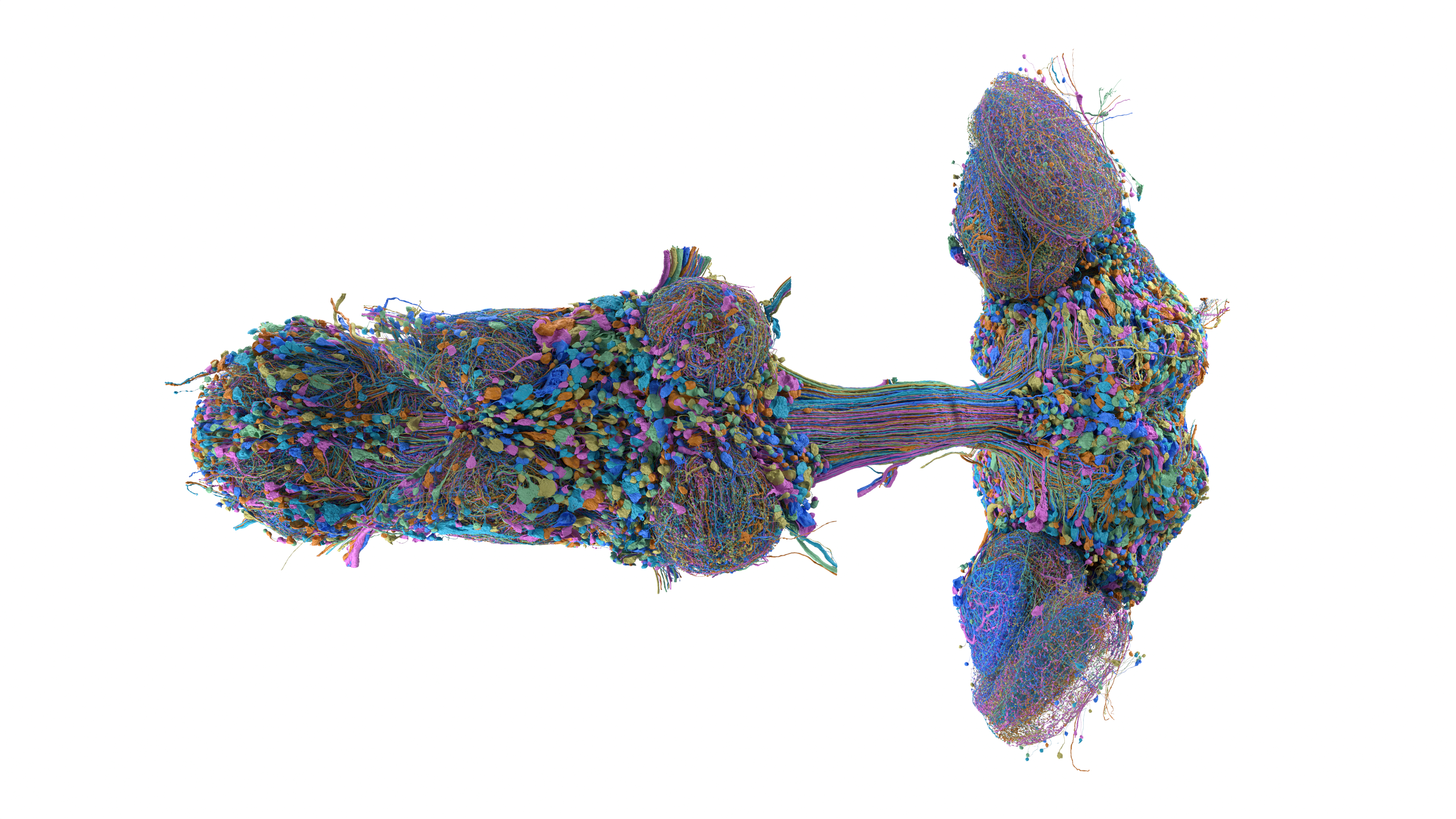
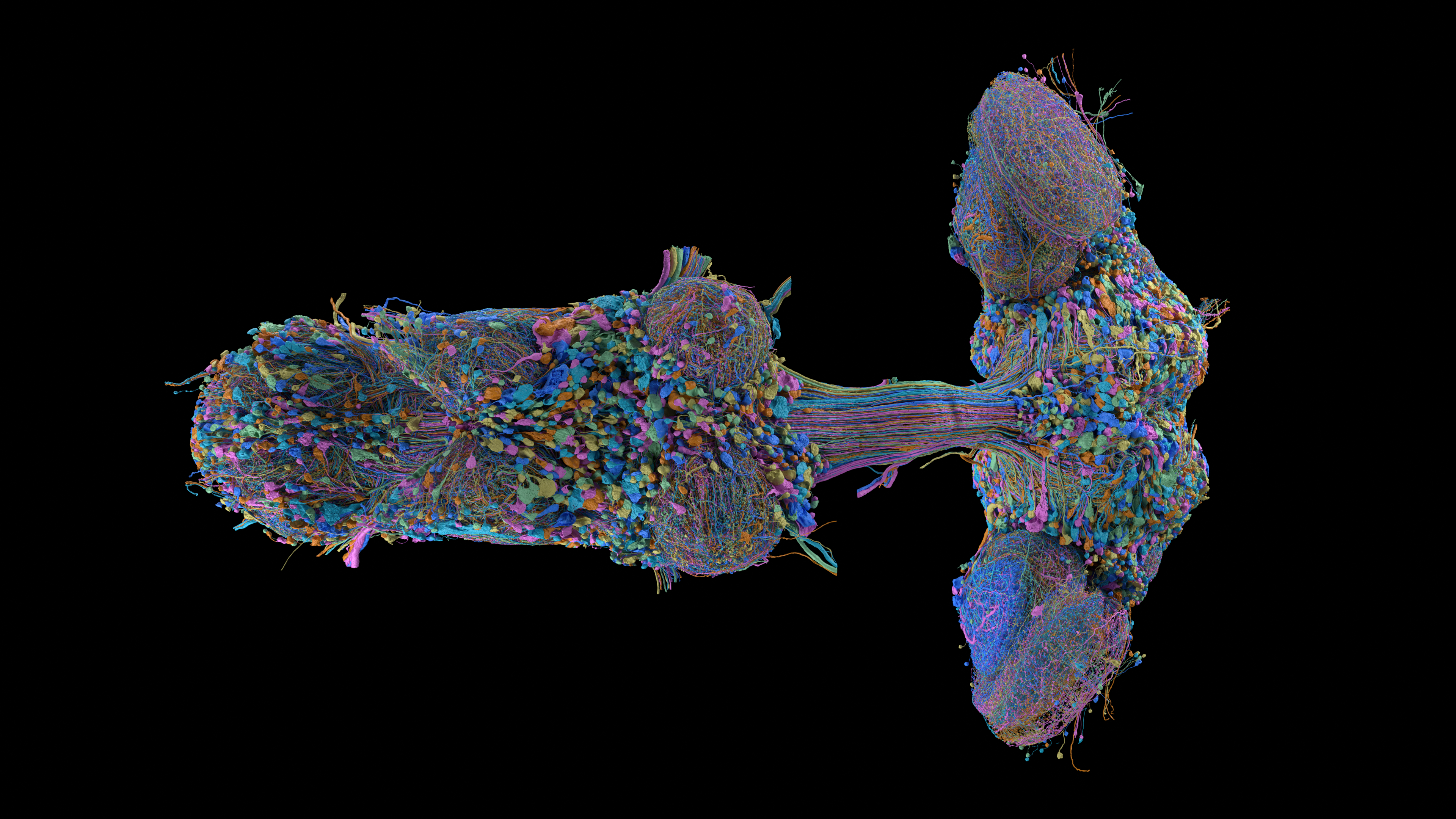
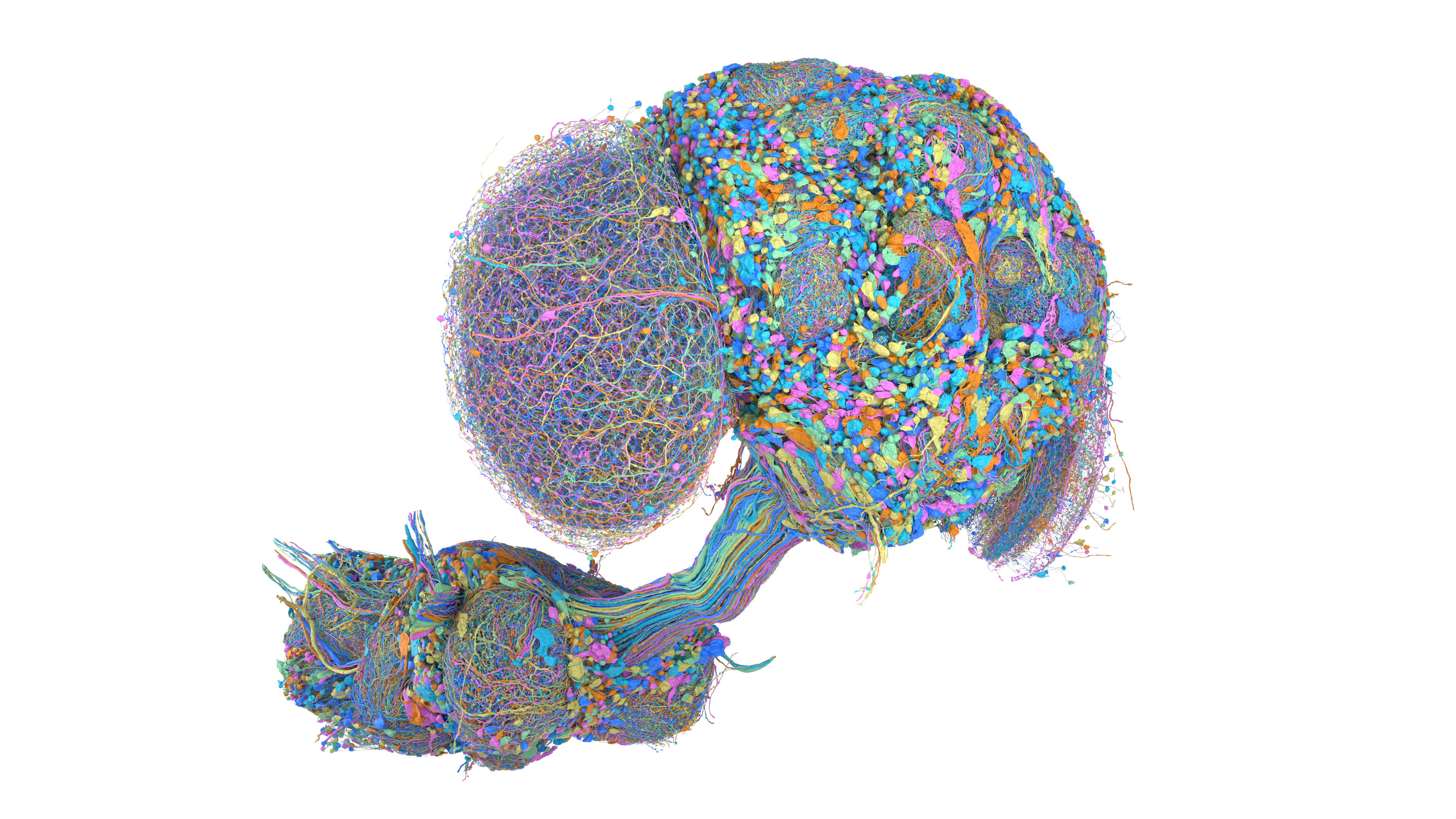
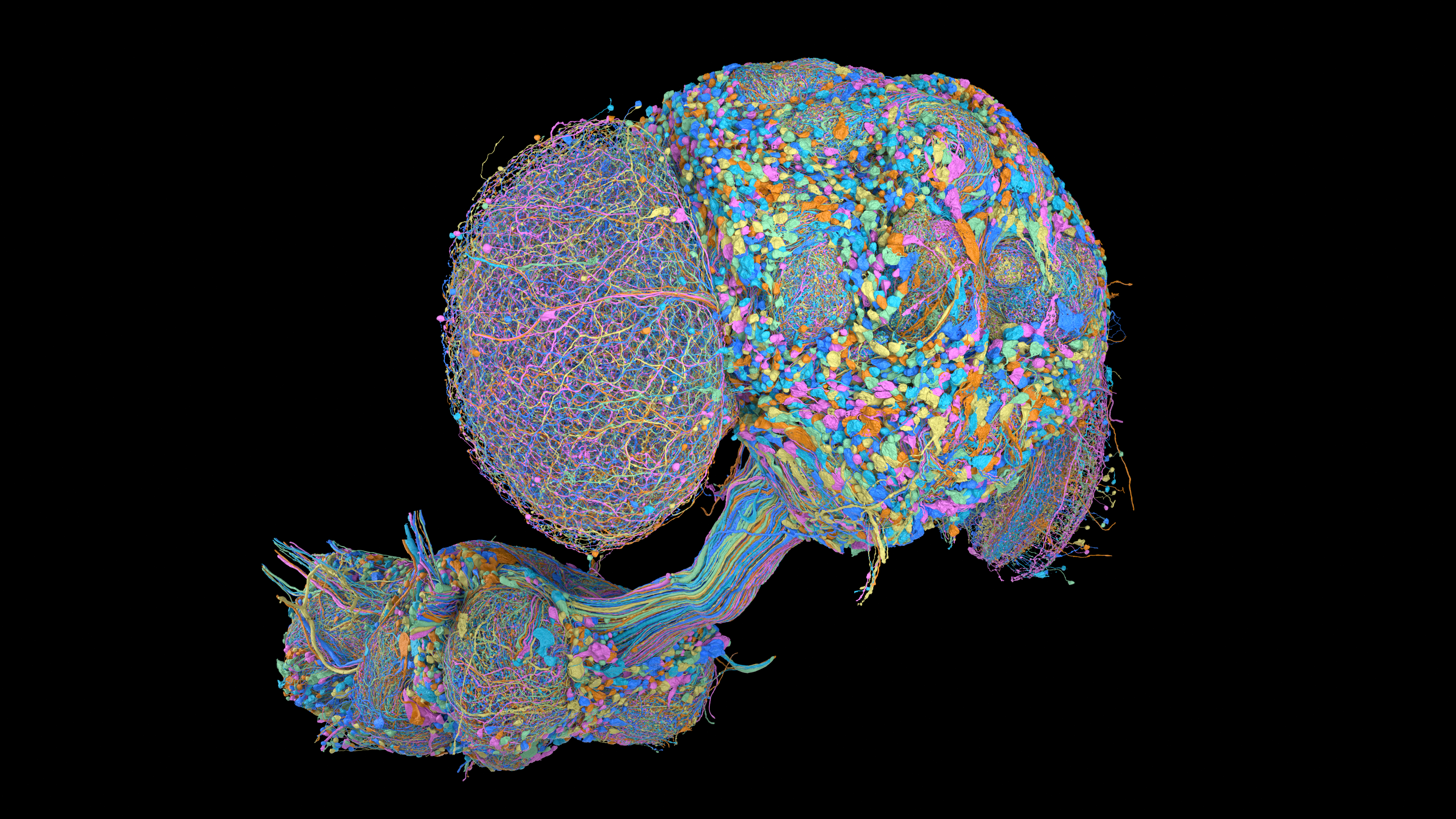
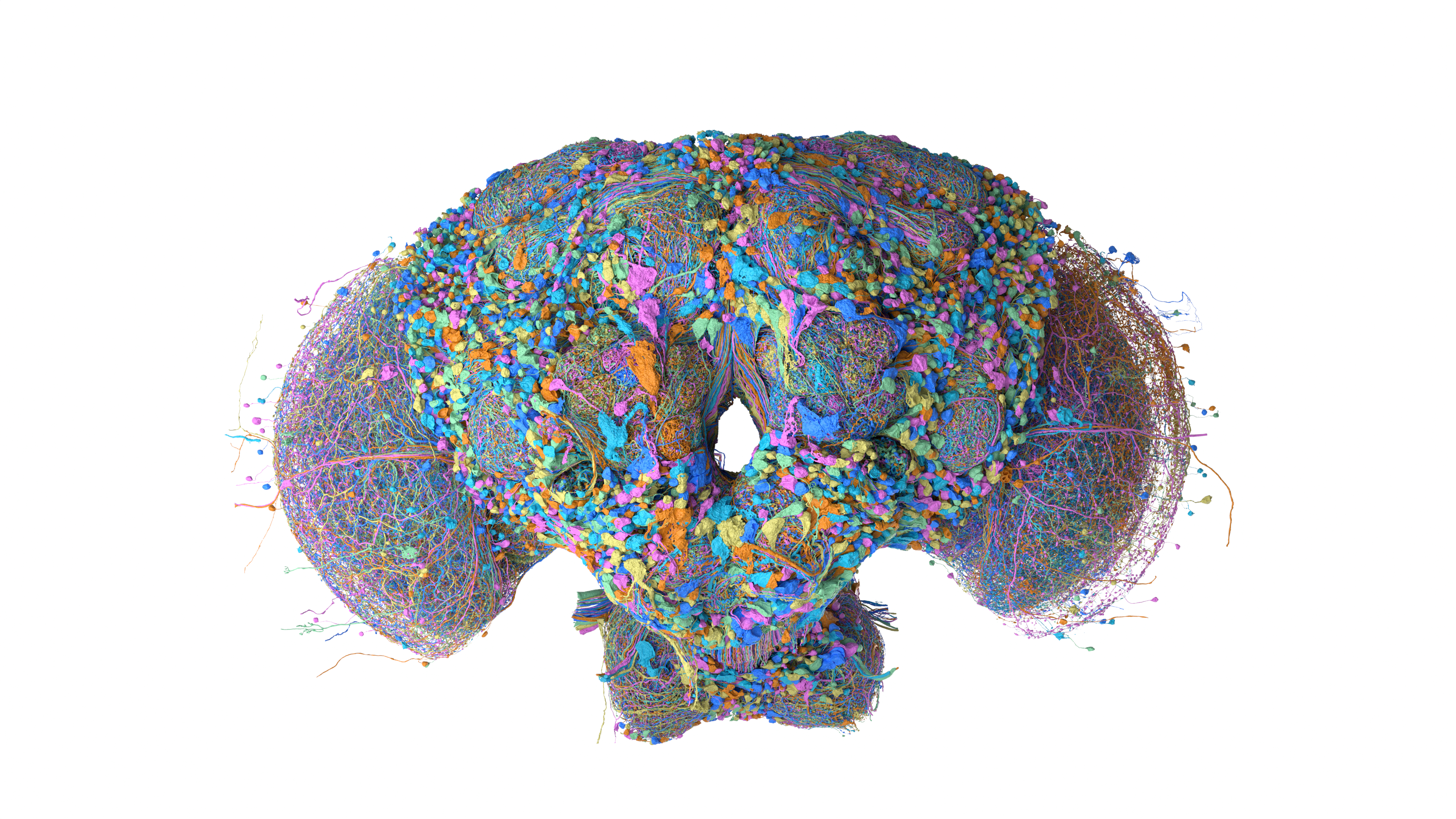
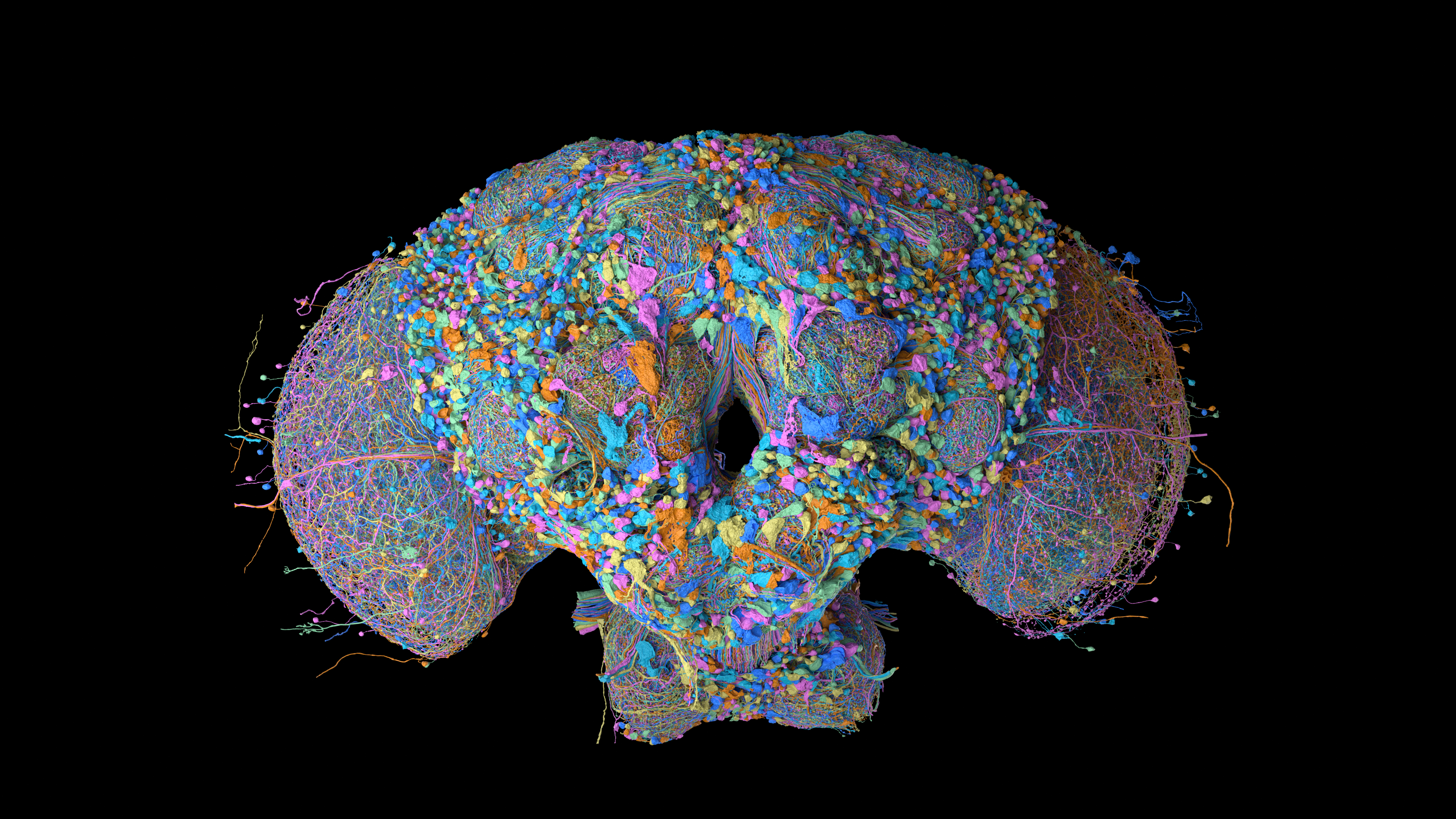
The male CNS connectome will allow researchers to compare male and female brains and understand complex social behaviors — like mating and aggression — that can vary by sex. Data acquired and analyzed by the FlyEM Project Team at HHMI’s Janelia Research Campus, the Cambridge Connectomics Group, and Google Research. Video by Philip Hubbard
This video shows all the types of neuron cells in the central nervous system (brain and ventral nerve cord) of the male Drosophila fruit fly. Data acquired and analyzed by the FlyEM Project Team at HHMI-Janelia, the Cambridge Connectomics Group, and Google Research. Video by Philip Hubbard.
The central nervous system of the Drosophila fruit fly has visual-motor pathways, which connect the visual neurons that help the fly detect objects, and the motor neurons that help the fly move in response to those objects. This video shows an example of such a pathway, from R1-R6 visual neurons to the DNg13 motor neuron. Data acquired and analyzed by the FlyEM Project Team at HHMI-Janelia, the Cambridge Connectomics Group, and Google Research. Video by Philip Hubbard and Alexandra Fragniere.
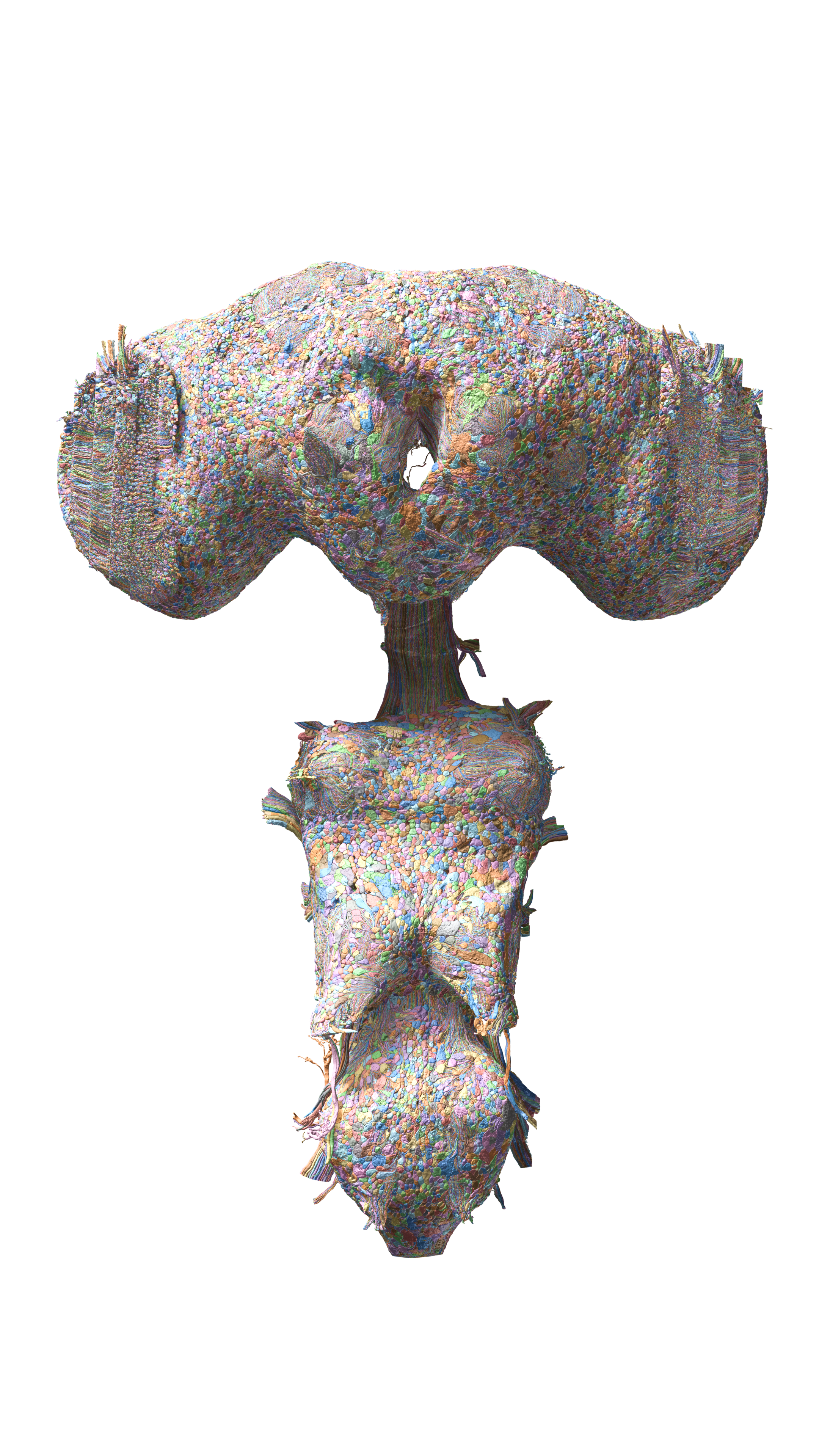
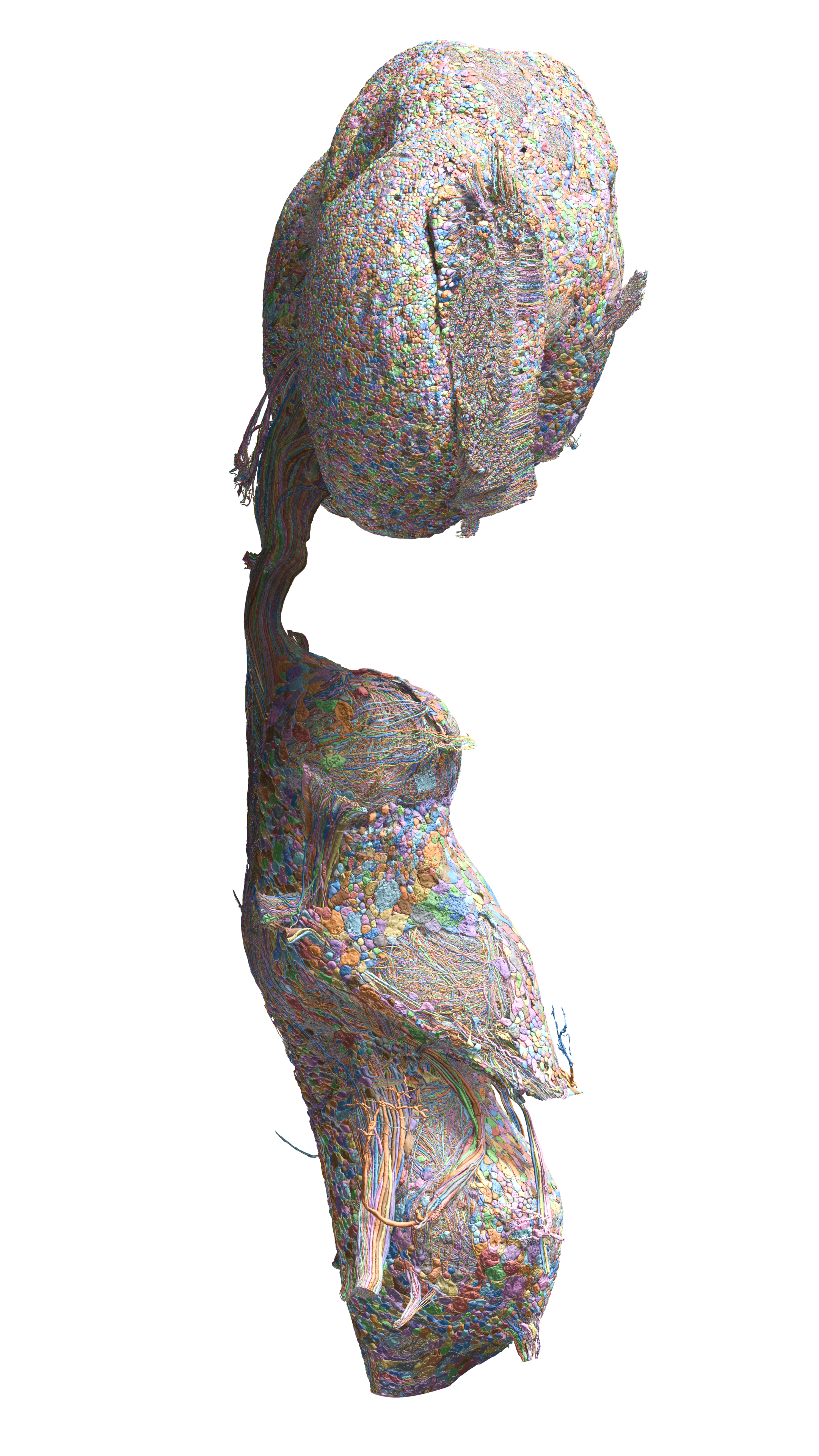
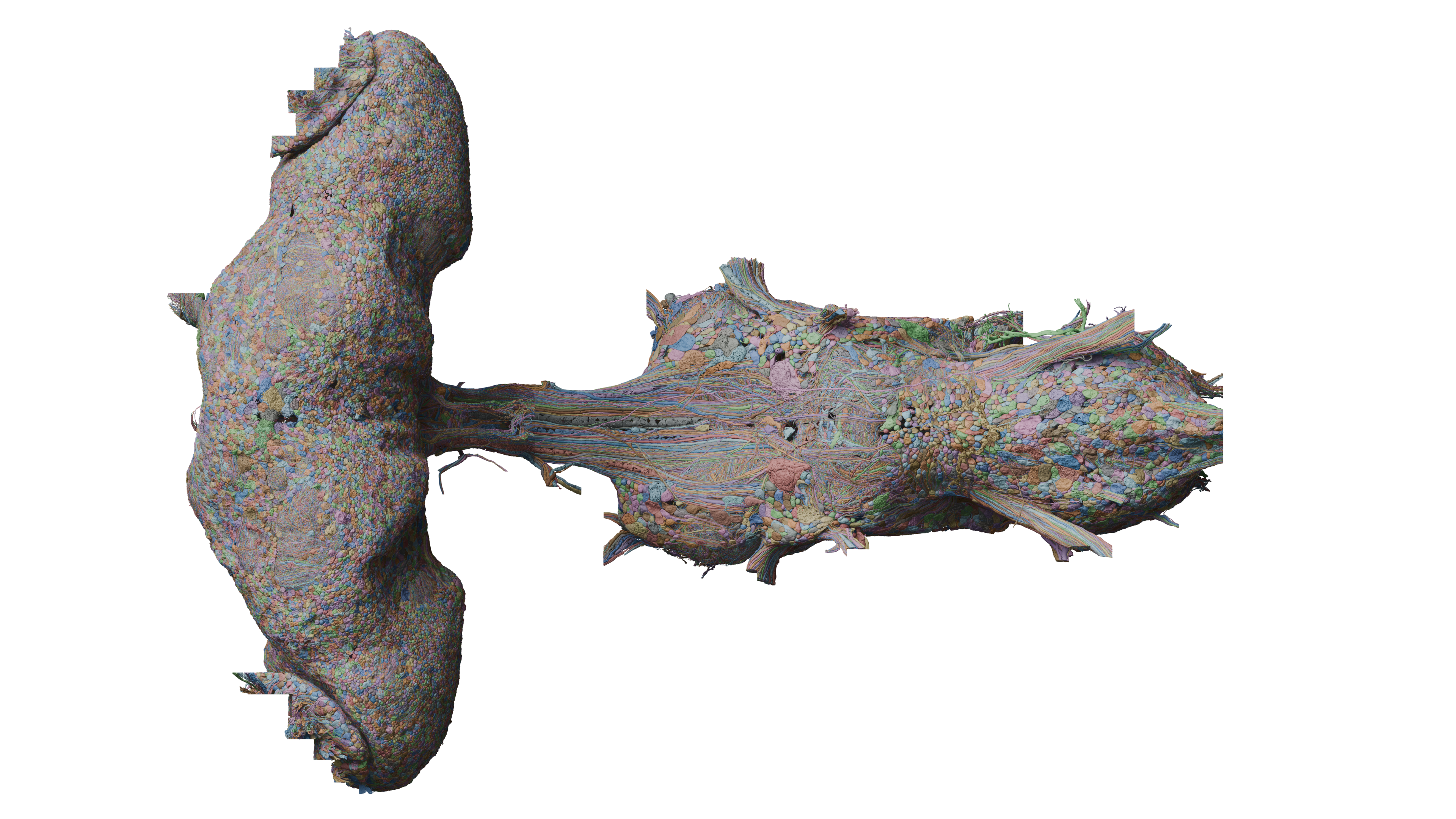
Some neurons in the central nervous system of the Drosophila fruit fly are “dimorphic”, existing in both males and females but connecting to different neighboring neurons. The neighbors may be “isomorphic”, the same in both male and female, or sex specific, or dimorphic themselves. This video shows one example, the type AOTU012, which is present in left and right instances. Data acquired and analyzed by the FlyEM Project Team at HHMI-Janelia, the Cambridge Connectomics Group, and Google Research. Female data acquired by the FlyWire project. Video by Philip Hubbard and Isabella Beckett.A small subset of the cells in the Male fly brain. Blue neurons are male-specific. Orange neurons are sexually dimorphic.All neurons of the male CNS. The VNC has been artificially pivoted down to make it easier to visualize both brain and VNC from a single viewpoint.All neurons of the male CNS. The VNC has been artificially pivoted down to make it easier to visualize both brain and VNC from a single viewpoint.All neurons of the male CNS.All neurons of the male CNS.A single representative cell from each of the 11,710 neuron types in the dataset, which contains 166,700 neurons in total.A single representative cell from each of the 11,710 neuron types in the dataset, which contains 166,700 neurons in total.A single representative cell from each of the 11,710 neuron types in the dataset, which contains 166,700 neurons in total.A single representative cell from each of the 11,710 neuron types in the dataset, which contains 166,700 neurons in total.A single representative cell from each of the 11,710 neuron types in the dataset, which contains 166,700 neurons in total.A single representative cell from each of the 11,710 neuron types in the dataset, which contains 166,700 neurons in total.
This project is a collaboration between FlyEM (HHMI Janelia), the University of Cambridge (Dept. of Zoology), the MRC Laboratory of Molecular Biology, and Google Research.